

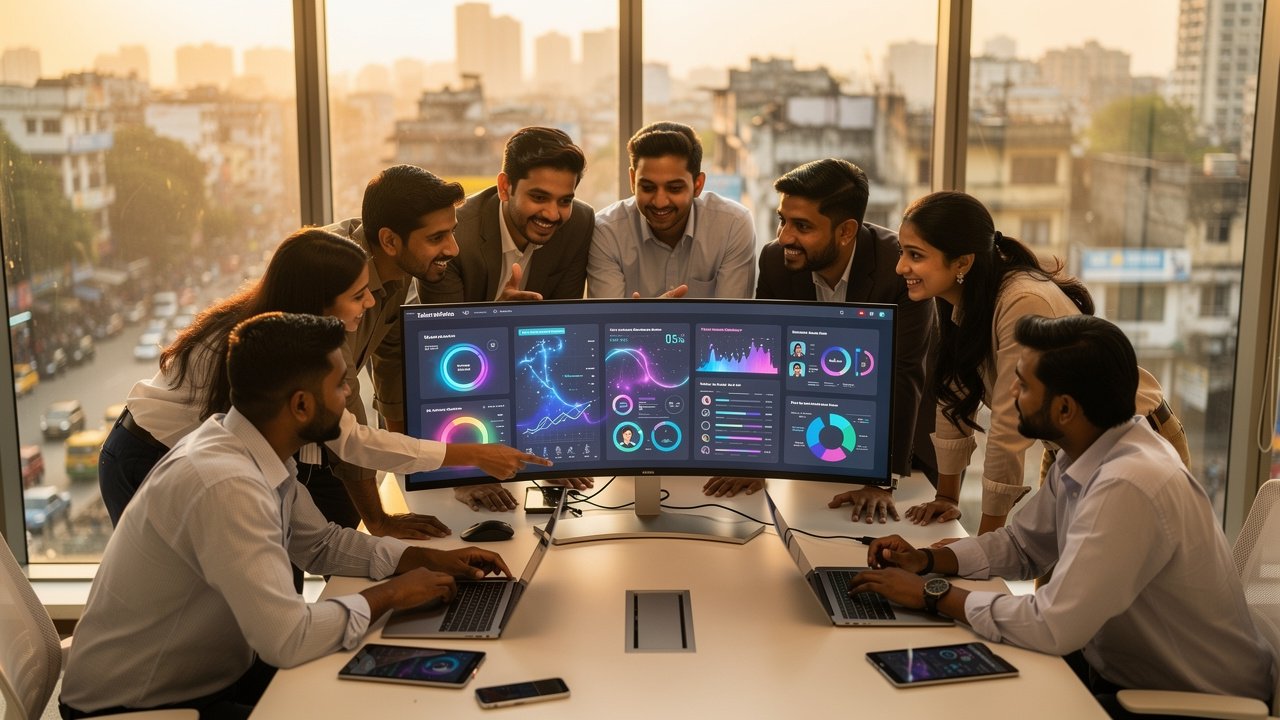
Traditional hiring in India is buckling under huge applicant volumes, and AI recruitment India is changing how companies hire. By automating sourcing, resume screening, chatbots, and matching, AI helps employers fill roles faster, reduce bias, and base decisions on data.
The problem is simple. Recruiters at SMEs, startups, and large enterprises drown in CVs, lose strong candidates to faster rivals, and struggle with remote and Tier 2 or 3 hiring. Manual processes slow growth and make hiring quality very uneven.
AI recruitment uses machine learning, natural language processing (NLP), and automation to create a semi-automated hiring process across the funnel, from job ads to onboarding. In this guide, you will see what AI recruitment is, the main use cases, benefits such as speed and fairness, real adoption trends in India, and a clear implementation roadmap where partners like Smart Hiring India support the digital hiring foundation.
“What gets measured gets managed.” — Peter Drucker
That quote sums up AI-based hiring well. AI brings structure and measurement to a part of business that has long relied on gut feel.
Stay with this article to see how to move from theory to a practical AI hiring plan for your business.
Key Takeaways
- AI recruitment in India uses smart tools for sourcing, screening, and assessment so employers cut time-to-hire and cost-per-hire while raising hiring quality. It turns high-volume hiring into a manageable, data-led process. Even small HR teams gain an edge against larger brands.
- Core technologies include NLP, machine learning, Generative AI, and RPA, which read messy CVs, rank applicants, personalise messages, and handle admin tasks. These tools work well with Indian job boards, WhatsApp, and multilingual candidates.
- Real use cases cover resume screening, AI chatbots, programmatic job ads, gamified tests, and onboarding support. Employers must still handle risks around algorithmic bias, DPDP Act data rules, and over-automation.
- A phased roadmap starts with pain-point analysis, pilots, integration with ATS or HRIS, HR upskilling, and ongoing measurement. Digital partners such as E Com Web Solutions help design careers sites, connect tools, and keep data flows secure.
What Is AI Recruitment And Why Does India Need It Now?

AI recruitment is the use of artificial intelligence, data, and automation to manage sourcing, screening, and selection so hiring becomes faster and more accurate. In the Indian context, AI recruitment in India responds directly to massive applicant numbers, skill gaps, and rising competition for talent. It moves hiring away from guesswork and towards measurable, repeatable processes.
According to the World Bank, India has a labour force of more than 500 million people. A single opening on Naukri or LinkedIn can attract thousands of applicants from Bengaluru, Mumbai, Gurugram, and dozens of Tier 2 cities. Human reviewers cannot reliably read that many CVs without missing strong profiles or letting bias slip in.
India also faces a shortage of niche skills in SaaS, cloud, cybersecurity, analytics, and marketing technology. Startups and tech-led firms race to hire the same engineers, product managers, and digital marketers. AI hiring tools in India help employers move quickly by flagging the best matches within hours, not weeks.
Cost pressure adds another layer. Many SMBs cannot grow HR headcount every time hiring needs spike. AI recruitment lets a small team run an automated hiring process that used to need several recruiters. It supports remote hiring, multilingual candidates, and screening for adjacent skills, which all matter in a wide Indian talent pool. Without AI, the gap between high hiring demand and limited recruiter capacity keeps widening.
How AI Recruitment Differs From Traditional Hiring Methods
AI recruitment differs from traditional methods because it focuses on context, prediction, and automation instead of simple keyword matching and manual review. Older applicant tracking systems looked for exact words and left the hard judgement to overworked recruiters.
AI-based talent acquisition technology reads CVs more like a human, noticing that an SDE and a full stack developer may have comparable skill sets even if titles differ. It scores candidates on skills, history, and likely fit rather than only job titles or famous institutes.
Here is a quick comparison to make this clearer:
| Aspect | Traditional Hiring | AI-Based Hiring |
|---|---|---|
| CV Review | Manual keyword scanning | NLP parses context and skill adjacencies |
| Sourcing | Job boards and manual search | Programmatic ads and AI candidate sourcing across the web |
| Decision Support | Gut feel and basic filters | Machine learning scores and predictive analytics |
| Recruiter Focus | Admin work and email follow-ups | Relationship building, interviews, and offer management |
This shift turns hiring from reactive vacancy filling into continuous, forward-looking talent mapping.
Core AI Technologies Powering AI Recruitment India
Core AI technologies in recruitment combine NLP, machine learning, Generative AI, and RPA to cover each step of the hiring process. In India, these tools sit on top of job sites like Naukri and Indeed, professional networks such as LinkedIn, and messaging channels like WhatsApp to match local behaviour.
Natural language processing helps resume screening software read messy CVs, pull skills from text blocks, and match them against job needs. Machine learning in hiring studies past hires and later performance data so it can rate new candidates on likely success. According to McKinsey & Company (https://mckinsey.com), activities that account for about a third of HR time can be automated with current technology, which shows how large the impact can be.
Generative AI supports recruiter and marketing teams by writing inclusive job descriptions, personalised outreach on LinkedIn, and interview question sets aligned to a candidate profile. Conversational AI running on WhatsApp or web chat handles large numbers of candidate questions, freeing people for deeper work.
Robotic process automation links all of this to calendars, email, and HRIS data. RPA bots schedule interviews, send reminders, and update statuses across tools such as Zoho Recruit, Workday, or SAP SuccessFactors. Smart Hiring India often helps employers by building career portals and integration layers so these AI tools sit neatly inside the wider HR technology in India without extra manual steps.
“AI is a tool. The choice about how it gets deployed is ours.” — Oren Etzioni
That applies strongly to recruitment: the same algorithms can either narrow or widen access to opportunity, depending on how they are configured.
NLP, Machine Learning, And Generative AI: What Each Does For Recruiters
To see how these technologies help day-to-day recruiting, it helps to separate their roles:
- NLP (Natural Language Processing)
NLP gives recruiters clean, structured data from unstructured CVs and profiles. It can read PDF, Word, or even scanned documents, standardise job titles, and support multilingual outreach to candidates in Tier 2 or 3 cities. This means fewer missed matches caused by formatting issues. - Machine Learning
Machine learning in hiring studies which past applicants turned into high performers, then scores new profiles against those patterns. It can estimate offer acceptance chances and likely tenure, which helps hiring managers choose between similar candidates. This type of predictive analytics is especially useful for SaaS and consulting firms with high hiring volumes. - Generative AI
Generative AI helps with communication. It writes customised InMail messages, follow-up emails, and role-specific questions based on a candidate portfolio or GitHub link. Recruiters still approve messages, but they no longer start from a blank page. - RPA (Robotic Process Automation)
RPA supports everything above by handling admin tasks like calendar sync and status emails.
Together, NLP, ML, Generative AI, and RPA form the engine behind modern recruitment automation software.
Key Use Cases: How AI Is Applied Across The Recruitment Lifecycle
AI recruitment in India appears at every point of the hiring lifecycle, from the first job ad to onboarding. Each stage gains speed and consistency, which is why AI talent acquisition is spreading across IT, BPO, manufacturing, and even smaller regional businesses.
For sourcing, AI tools scan LinkedIn, Naukri, GitHub, Behance, and even public websites for profiles that match target skills. Programmatic advertising engines then place job ads automatically where the right people spend time, such as YouTube, Instagram, or specific news portals. According to NASSCOM, India now has thousands of SaaS firms, many of which rely on this type of smart hiring approach to keep up their growth.
Screening and matching come next. Automated resume screening reads each CV, pulls out skills, and ranks candidates in a scoring dashboard. Recruiters can filter by score, skills, or experience range while keeping an eye on diversity and inclusion goals.
Further along, AI interview tools run asynchronous video interviews and coding tests. Candidates complete them at a convenient time, which suits shift workers, BPO applicants, and people in different time zones. AI analyses spoken content and code quality but avoids risky facial micro-expression checks that can introduce bias.
Onboarding also gains from AI. Chatbots on Microsoft Teams or Slack answer new hire questions, share policy documents, and remind people to finish forms. By the time a new employee joins, the process feels smooth and modern instead of slow and confusing.
Automated Resume Screening And Intelligent Shortlisting
Automated resume screening targets the pain point that almost every Indian employer feels first. AI-powered applicant tracking system software reads each application, extracts skills, tools, and outcomes, and then scores candidates against a job profile. This moves hiring teams away from prestige-based filters and towards skill-based matching.
Blind mode is now common in smart hiring tools. The system hides personal details such as name, gender, age, and sometimes college name during the first pass. According to research by the Harvard Business School, blind hiring tends to reduce bias against certain groups, which mirrors early results from Indian firms that have tried it.
Recruiters then see a ranked list of candidates who match core skills and related abilities, not only exact keywords. Instead of reading every CV, they spend time on the top segment of applicants who have already passed automated checks.
Modern AI hiring tools in India plug directly into existing ATS platforms, showing scores, notes, and risk flags inside the same screen that HR teams already know. Smart Hiring India can support by building user-friendly dashboards on top, so hiring managers view AI insights without technical clutter.
AI Chatbots, Asynchronous Video Interviews, And Automated Assessments

AI chatbots give candidates a simple way to connect at any hour. Many Indian employers now run WhatsApp chatbots that answer role questions, share links to apply, and gather basic data in a friendly chat style. This approach works very well for BPO and blue-collar hiring, where mobile use is high.
After shortlisting, asynchronous video interviews save time on both sides. Candidates receive a set of questions, record answers on their phone or laptop, and submit within a deadline. AI then uses NLP to study clarity, structure, and content of answers rather than facial expressions. Major companies such as Unilever and Accenture use similar methods in various regions, which has helped normalise this format.
Automated coding and gamified assessments support technical and problem-solving roles. Platforms like HackerRank or Mettl score code on efficiency, readability, and test coverage, while game-based tests assess logic and attention. AI in human resources practices means that recruiters see a clear comparison of candidates based on standard tests, not only CV claims.
Industry groups and privacy experts now advise against deep analysis of micro-expressions or subtle facial cues. Many Indian employers are shifting to content-only analysis, which reduces bias risk and keeps assessments aligned with DPDP expectations.
Strategic Benefits For SMBs, Startups, And Enterprises In India

AI recruitment in India delivers different benefits depending on company size, but the core theme is the same: employers gain speed, better matches, and more predictable hiring outcomes while spending less time on admin. For business owners and senior leaders, this translates directly into faster growth and lower hiring risk.
For startups, AI hiring tools in India help close key roles before competitors move. When small founding teams use automation for sourcing, screening, and basic communication, they can spend their time speaking with top candidates instead of reading every CV. Employer brand also improves, because applicants receive quick updates and a modern experience.
For SMBs, the gains are mainly around cost and consistency:
- Less dependence on external agencies
- Standard processes even when there is only one recruiter
- Better reporting on time-to-hire and cost-per-hire
According to SHRM, average cost-per-hire can reach several weeks of salary when agency fees and wasted time are included. AI-driven self-service hiring reduces this spend while keeping control inside the business.
Large enterprises gain scale. When tens of thousands of applications reach systems like Workday or SAP SuccessFactors, AI candidate sourcing and matching tools prevent candidate black holes. Chatbots and automated status updates keep applicants informed, which helps brands that appear on Glassdoor and AmbitionBox.
Reducing Time-To-Hire, Cost-Per-Hire, And Early Attrition
Recruitment automation software sharply reduces the time it takes to move a candidate from application to offer. For example, Indian SaaS firms that automate sourcing, screening, and scheduling often reduce time-to-hire from about 45 days to closer to 15, based on internal case studies shared by firms such as Freshworks and Zoho. Faster decisions matter when strong engineers hold multiple offers.
Cost-per-hire also falls because recruiters spend fewer hours on manual work and rely less on agencies. AI for employers hiring at volume handles top-of-funnel tasks, so HR teams can stay lean even when hiring spikes.
Machine learning then links pre-hire scores to later performance and retention data in HRIS systems. Over time, the model learns which traits predict good results in each role. Better matches mean lower first-year attrition, which reduces the cost and disruption linked to replacing people within months of joining.
Navigating Challenges: Algorithmic Bias, Ethics, And DPDP Act Compliance

AI recruitment in India brings risks along with rewards, and employers must address them early. The main concerns are hidden bias in models, lack of transparency, and data privacy rules under the DPDP Act 2023. If these are ignored, the same tools that save time can harm fairness and brand trust.
Algorithmic bias arises when AI learns from past hiring data that already favoured certain groups, such as male engineers from IITs or candidates from metro cities only. If that history is not corrected, the model may keep recommending similar profiles and downranking others. Research from the Nielsen Norman Group shows that biased training data is one of the main causes of unfair AI behaviour.
The second concern is the black-box effect. Some deep learning models give scores without clear reasons, which is risky in hiring. Candidates, internal audit teams, and even regulators are now asking for explainable AI so decisions can be checked. Global measures such as New York City Local Law 144 show where regulation is heading, and Indian firms are watching closely.
Data privacy adds another layer. The Digital Personal Data Protection Act (DPDP) 2023 sets strict rules on consent, use, storage, and deletion of personal data. AI hiring systems process CVs, test scores, videos, and chat logs, which fall under this law. The Ministry of Electronics and Information Technology expects firms to prove consent and allow deletion requests.
Smart Hiring India can assist by designing secure career sites, consent flows, and data pipelines around AI tools so that recruitment technology trends align with DPDP standards from day one. This reduces the chance of fines and reputational damage.
How To Audit AI Systems For Bias And Keep Hiring Fair
Bias audits turn abstract concerns into clear checks. HR and legal teams should start by reviewing training data for imbalances across gender, caste, region, and college type. If the historical dataset is skewed, retrain models with more balanced or synthetic data.
Next, run test applications through the system and compare outcomes for different groups with similar skills. If one group receives lower scores without a skills gap, the model needs adjustment. According to IBM, continuous testing like this is central to fair AI.
Blind hiring should be the default setting in early stages so the AI focuses on skills and results. Employers should also choose vendors that offer explainable AI so each rejection can be tied to clear, job-linked reasons.
Finally, all candidate touchpoints must include clear consent language in line with the DPDP Act. Contracts with AI vendors should cover storage duration, data localisation in India, encryption standards, and the right to erasure from both live systems and training sets.
How To Build Your AI Recruitment Implementation Roadmap

An AI recruitment roadmap helps Indian employers move in structured steps instead of buying random tools. The goal is to connect artificial intelligence in recruitment with business metrics such as revenue, billable hours, or project delivery speed.
First, company leaders must agree on why they want AI recruitment in India. Is the main challenge volume screening, finding better quality candidates, or cutting agency spend? Clear goals avoid wasted budget. Then, HR, IT, and business heads can agree which parts of the process should be automated first.
Consulting partners such as Smart Hiring India can play a key role here. They help design mobile-friendly career pages, integrate AI-powered applicant tracking systems with existing HRIS, and set up analytics that track time-to-hire and conversion rates. Their focus on clean code and measured ROI means AI hiring tools fit into the wider web and marketing stack instead of becoming isolated projects.
According to Deloitte, organisations that treat AI adoption as a cross-functional programme see better results than those that leave it only to HR. That is why change management, user training, and clear communication matter as much as software licences.
“The greatest danger in times of turbulence is not the turbulence; it is to act with yesterday’s logic.” — Peter Drucker
For recruitment leaders, “yesterday’s logic” often means manual CV screens and slow feedback loops. AI gives them a way to update that logic.
Step-By-Step Adoption From Needs Assessment To Full Integration
A simple step-by-step path keeps AI hiring projects under control:
- Step 1 – Needs Assessment
Map the current hiring funnel, measure time spent on sourcing, screening, scheduling, and reporting, and list where delays are highest. Focus on one or two big pain points rather than every problem at once. - Step 2 – Pilot A Single Module
Start with one tool such as a careers-page chatbot, automated resume screening, or an online coding assessment. Run it for a few roles, then compare time-to-hire, candidate satisfaction, and recruiter workload with earlier rounds. - Step 3 – Connect With Existing Systems
Use APIs to link the pilot tool to your ATS or HRIS so data flows automatically. Avoid tools that force recruiters to copy and paste data between systems. Partners like E Com Web Solutions can develop these connectors and keep performance steady. - Step 4 – Upskill HR
Train recruiters to read AI scores, adjust filters, and spot edge cases where human judgement must override machine output. Shift their role from manual admin to talent advisory work. - Step 5 – Measure And Refine
Track metrics such as pipeline conversion, cost-per-hire, and first-year attrition for AI-supported versus traditional roles. Use those insights to tweak models or expand AI coverage to more functions and regions.
The Road Ahead: What Is The Future Of AI Recruitment In India?
The future of AI recruitment in India is moving from pure hiring automation towards full talent optimisation. This means AI will not only find people outside the company but also match, grow, and retain people inside it.
Predictive models will watch signals from HR systems, engagement tools, and learning platforms to spot who might leave in the next few months. HR teams can then offer new projects, pay reviews, or learning paths before resignations appear. Internal talent marketplaces will suggest roles to employees based on skills and goals so vacancies can be filled from within first.
Candidate experience will also change. Careers sites will show different content to each visitor based on their profile, similar to how Netflix or Amazon personalise feeds. AR or VR tools may let candidates walk through a virtual plant or call centre before joining, while AI observes how they handle realistic situations.
Employers that combine this high level of technology with warm, human contact will stand out in India’s fast moving talent market.
The Final Word On AI Recruitment For Indian Employers
AI recruitment in India is no longer a side experiment. It is a practical way for startups, SMBs, and large enterprises to handle huge applicant volumes, hire for scarce skills, and keep candidates engaged from first click to first day.
The key message is balance. AI hiring tools and recruitment automation software manage sourcing, screening, and assessments with speed and accuracy, but people still set strategy, guard fairness, and build relationships. Employers must address algorithmic bias, explainability, and DPDP Act duties at each stage of tool selection and configuration.
For many organisations, the best next step is a structured needs assessment, followed by a small pilot in resume screening or chat support. From there, integrations, dashboards, and careers experiences can grow with help from experienced hiring partners like Smart Hiring India. With this approach, AI becomes a steady driver of better hiring outcomes, not a risky experiment.
Frequently Asked Questions
Question: What is AI recruitment, and how does it work in the Indian context?
Answer: AI recruitment is the use of NLP, machine learning, and automation to handle sourcing, screening, and selection. In India, it manages huge applicant pools from Naukri or LinkedIn, reads multilingual CVs, and supports remote hiring across Tier 2 and Tier 3 cities through programmatic ads, resume scoring, and chatbots.
Question: Which AI hiring tools are most commonly used by Indian companies?
Answer: Common categories include AI-powered applicant tracking systems, WhatsApp-integrated conversational chatbots, automated coding and psychometric assessment platforms, and programmatic job advertising engines. Indian employers often work with digital partners such as Smart Hiring India to select and integrate these tools, then mix global SaaS platforms such as Workday or Greenhouse with local HR technology products like Zoho Recruit that are tuned to local job boards, languages, and compliance needs.
Question: Is AI recruitment suitable for small businesses and startups with limited HR budgets?
Answer: Yes. AI recruitment suits small businesses and startups because many tools use modular, pay-as-you-go pricing. By automating top-of-funnel work such as sourcing, basic screening, and updates, lean teams can compete with big brands, present a professional employer image, and keep agency costs under control without increasing HR headcount.
Question: How does the DPDP Act 2023 affect the use of AI in recruitment in India?
Answer: The DPDP Act 2023 requires explicit candidate consent, clear explanation of how data is used, limits on retention, and a right to erasure. Employers must pick AI vendors that store data securely in India where needed, offer strong encryption, and provide logs so automated decisions in recruitment can be reviewed if questions or disputes arise.
Question: Can AI eliminate bias in the hiring process entirely?
Answer: AI cannot remove bias completely, but it can reduce it when designed carefully. If trained on skewed past data, it can even make bias worse. Employers should use blind hiring modes, run regular bias audits, and choose explainable AI tools so they can inspect why certain groups receive higher or lower scores and adjust models where needed.